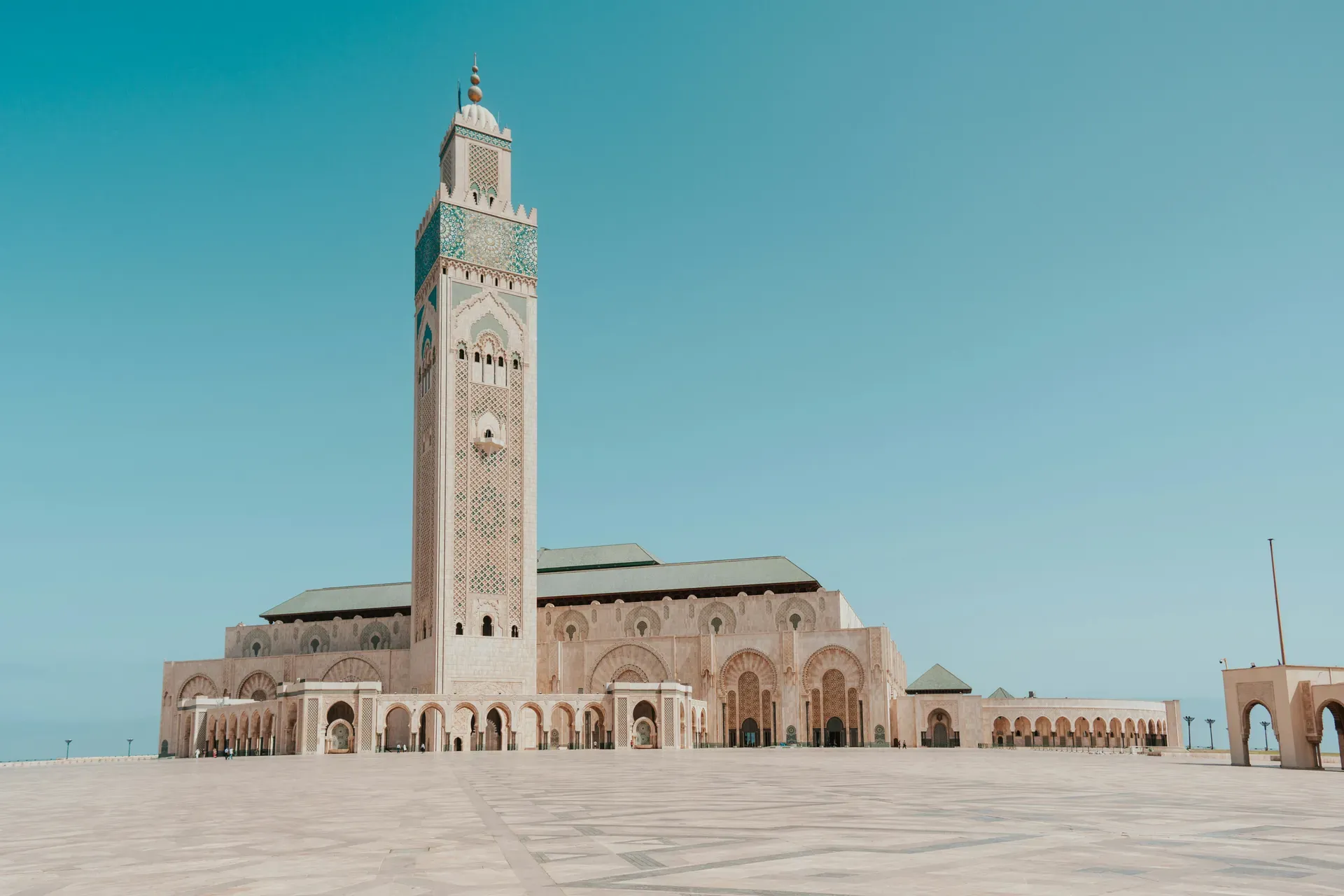
The Hassan II Mosque stands on a promontory above the Atlantic Ocean in Casablanca, Morocco. Its 210-meter minaret holds a laser pointing 30 kilometers toward Mecca.
The Hassan II Mosque occupies a rocky outcrop on the northwestern tip of Casablanca, with one-third of its foundation built directly over the Atlantic Ocean. Completed in 1993, the structure accommodates 25,000 worshippers inside the main prayer hall and another 80,000 in the surrounding outdoor plaza. It ranks as the largest functioning mosque in Africa and the seventh largest globally. The main building stretches 200 meters long, 100 meters wide, and 60 meters high. A 210-meter minaret anchors the southern edge of the complex, standing equivalent to a 60-story skyscraper.
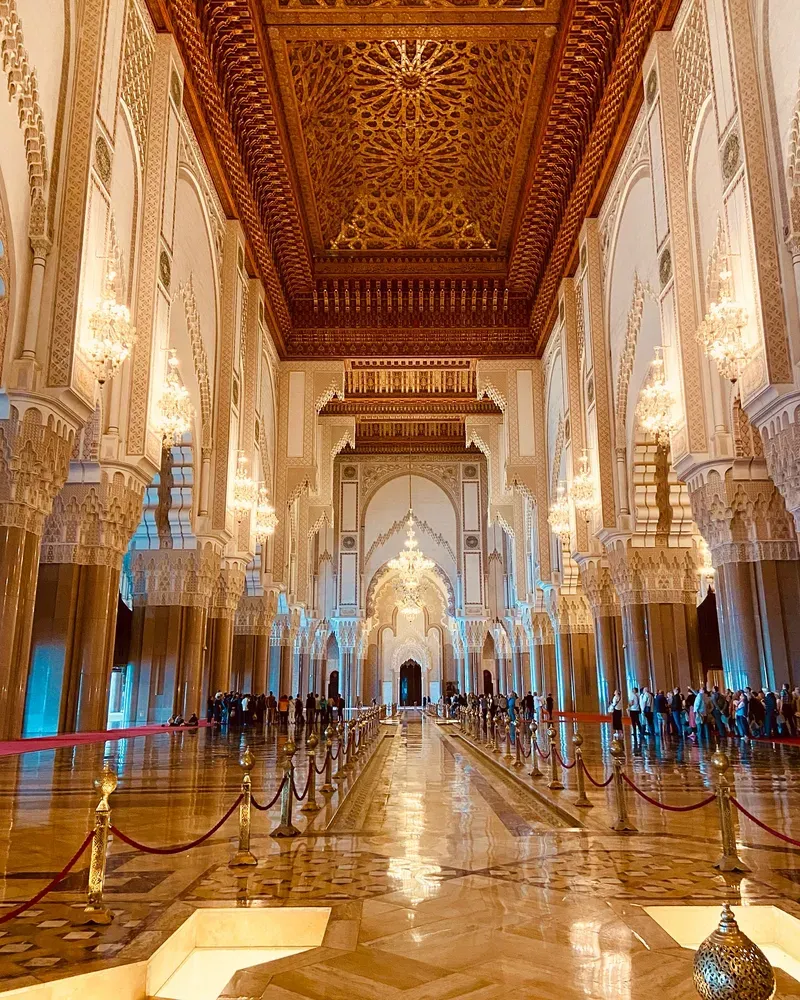
Visitors access the interior through guided tours, making it one of the few Islamic houses of worship in Morocco open to non-Muslims. Inside, 57 Venetian glass chandeliers hang above 10,000 square meters of hand-cut ceramic mosaics. The air smells of cedar wood from the massive ceiling and salt from the ocean outside. Atlantic spray regularly coats the exterior marble courtyards, creating a slipping hazard during high tide or winter storms. The sound of crashing waves provides a constant acoustic backdrop to the call to prayer.
Tour groups gather at the onsite museum office before entering the main hall. Morning tours at 09:00 or 10:00 provide softer lighting through the titanium and brass doors, avoiding the harsh afternoon glare. Friday access for non-Muslims is restricted to afternoon slots starting at 15:00 due to weekly congregational prayers. Reaching the site requires a 10-minute petit taxi ride from the Casablanca city center, costing roughly 15 to 30 MAD. Travelers arriving at Mohammed V Airport face a 35-kilometer journey. Taking the ONCF train to Casa Port station takes 45 minutes and costs 50 MAD, followed by a short taxi ride to the mosque gates.
Weather dictates the optimal time to visit the complex. March through June offers mild temperatures and manageable crowds. July and August bring high humidity and extreme tourist congestion, with dozens of tour buses idling in the parking lots by 08:30. January and February expose visitors to biting winds coming off the Atlantic, requiring heavy coats for the 500-meter walk from the ticket office to the main entrance. The site sits just a five-minute taxi ride from Rick's Café and a 15-minute walk from the Old Medina, allowing visitors to combine the architectural tour with historical exploration.
King Hassan II commissioned the mosque to celebrate his 60th birthday and provide Casablanca with a landmark monument. French architect Michel Pinseau designed the complex, drawing inspiration from the Quranic verse stating 'the throne of God was upon the water.' Pinseau, a non-Muslim, spent months studying traditional Moroccan architecture before drafting the final blueprints. Construction began on July 12, 1986. The original plan targeted a 1989 completion date. The sheer scale of the project pushed the inauguration to August 30, 1993.
Funding the $800 million project required a massive national effort. The King contributed one-third of the cost from royal funds. The remaining two-thirds came from a public subscription involving 12 million Moroccan citizens. Families donated varying amounts based on their income, and each contributor received a printed certificate acknowledging their financial participation. This funding model tied the physical structure to households across the entire country, transforming a royal decree into a national undertaking.
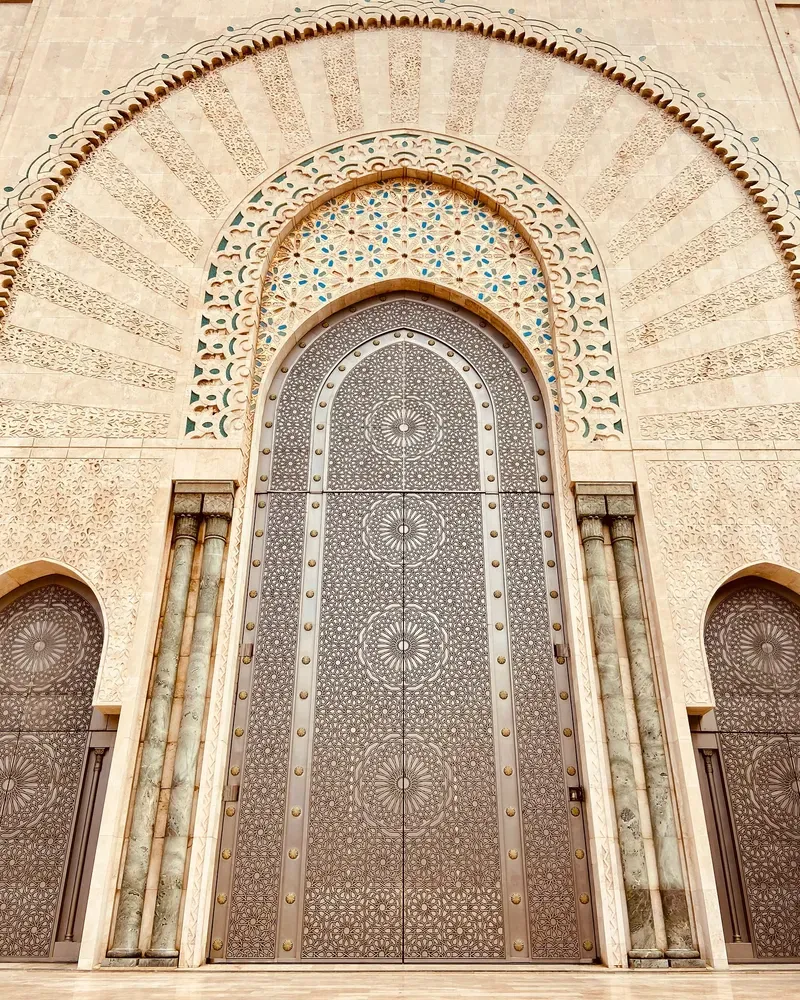
Building the structure demanded a relentless schedule. A workforce of 2,500 construction personnel and 10,000 master craftsmen operated in shifts, 24 hours a day, for seven years. They poured concrete foundations directly into the Atlantic seabed to support the promontory extension. Engineers designed the foundation to withstand constant wave impacts, tidal shifts, and saltwater corrosion. Workers installed massive exterior doors made of titanium and brass to resist the constant bombardment of corrosive salt air.
Logistics for material transport dominated Casablanca's port and highway systems for half a decade. Trucks hauled cedar wood from the Middle Atlas mountains, marble from Agadir, and granite from Tafraoute. Only the white granite columns and the 57 glass chandeliers came from outside Morocco, imported from Italy. The domestic sourcing of materials turned the construction site into a showcase of national resources.
Today, the mosque requires continuous maintenance to fight ocean erosion. Scaffolding frequently appears on the seaward walls as crews repair salt-damaged masonry. The official foundation manages these repairs, funding them partially through the 140 MAD entry fee charged to foreign adult tourists. Ignoring the 'guides' outside the complex claiming the mosque is closed prevents tourists from falling for common street scams; only official tours from the ticket office provide valid entry.
An 1,100-ton cedar wood roof covers the central prayer hall. Electric motors slide this massive structure open in five minutes, allowing worshippers to pray directly beneath the night sky during specific religious occasions. The cedar wood originates from the Middle Atlas mountains, chosen for its natural resistance to rot and insects. The roof panels feature intricate carvings and painted geometric motifs completed by artisans from Fez. Below the roof, 57 Murano glass chandeliers imported from Venice illuminate the space. The largest of these fixtures weighs 1,200 kilograms and requires a motorized winch system for cleaning and bulb replacement.
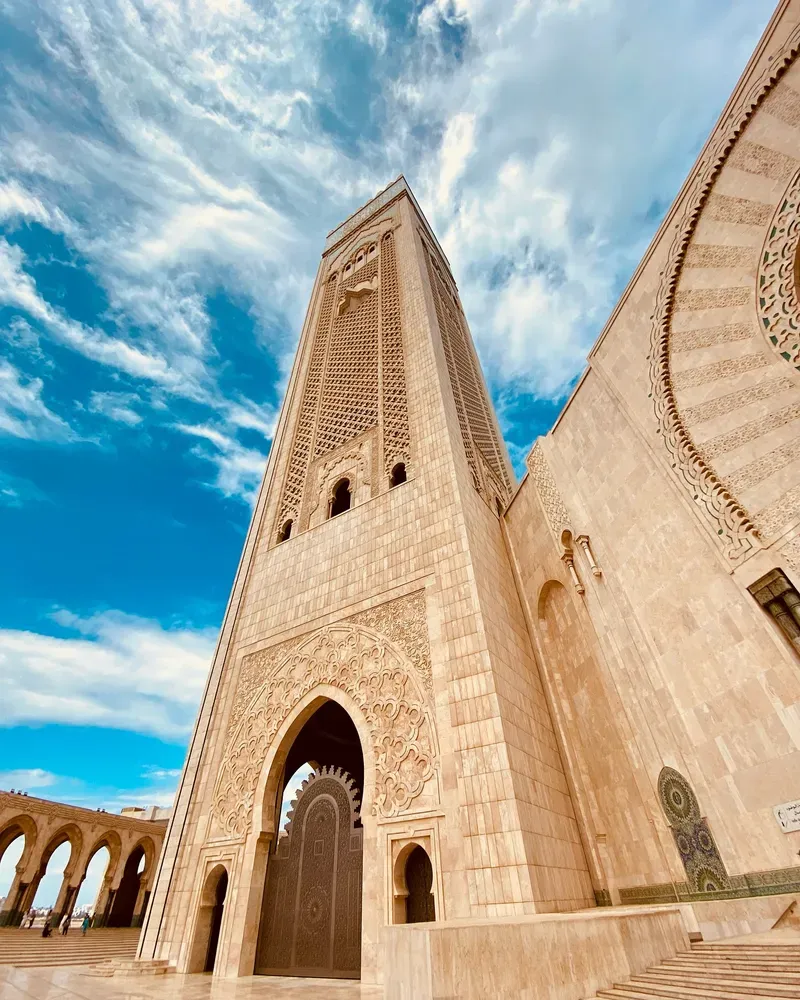
The 210-meter minaret dominates the Casablanca skyline. A laser mounted at its peak activates every evening, projecting a green beam 30 kilometers across the sky in the exact direction of the Kaaba in Mecca. The minaret houses a fast elevator for the muezzin, alongside a staircase containing approximately 1,400 steps. At the base of the complex, specific sections of the royal prayer areas feature glass floors suspended directly over the crashing Atlantic waves.
Artisans applied over 10,000 square meters of zellige tilework across the interior and exterior surfaces. These hand-placed ceramic mosaics form 80 distinct geometric patterns, utilizing traditional colors of green, yellow, blue, and white. The plasterwork above the tiles contains finely carved Arabic calligraphy detailing verses from the Quran. The central prayer hall features a heated floor system to keep worshippers warm during winter prayers. The exterior titanium doors require specialized cleaning solutions to maintain their shine against the corrosive sea mist.
In the basement ablution hall, 41 marble fountains carved into the shape of lotus flowers provide running water for ritual washing. The room utilizes tadelakt, a traditional waterproof plaster technique, to manage the high humidity. Visitors must remove their shoes before walking on the marble floors throughout the complex. The stone surface remains cold year-round despite the underfloor heating, which is rarely activated for tourist hours. Carrying thick socks prevents discomfort during the 45-minute guided interior walk.
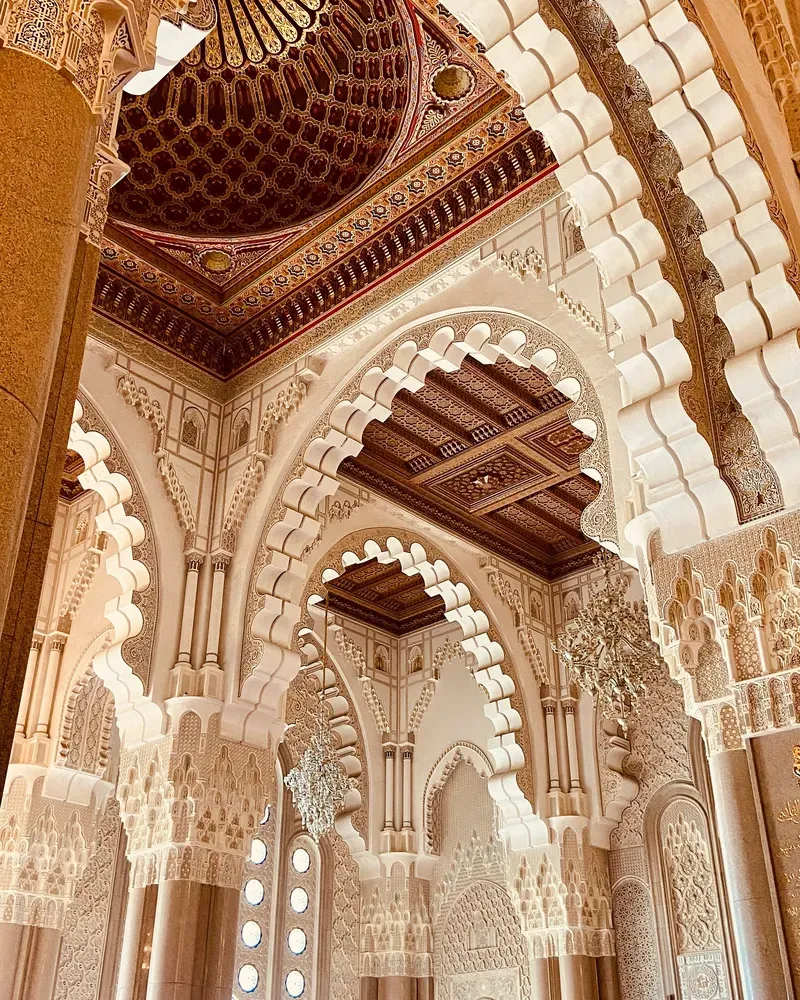
The structure functions as a living catalog of Moroccan craftsmanship. Woodcarvers from Fez, stone merchants from Taroudant, and mosaic artists from across the country spent years living on-site to complete the interior detailing. Their collective work elevates traditional Islamic geometric design to an industrial scale. The building proves that ancient artisan techniques can integrate with modern engineering elements like retractable roofs and laser guidance systems.
Allowing non-Muslims inside breaks from standard Moroccan religious protocols. Most active mosques in the country strictly prohibit non-worshippers from entering past the courtyard. This open-door policy turns the building into an educational space where foreign visitors observe Islamic architectural principles firsthand. Guides explain the function of the mihrab, the direction of prayer, and the ritual washing process during their daily tours.
Local residents utilize the massive outdoor plaza as a public gathering space. Families walk along the sea wall during sunset, and children play on the marble expanses outside of prayer times. The site forms a boundary between the dense urban grid of Casablanca and the open expanse of the Atlantic Ocean. It anchors the northern end of La Corniche, a beachfront promenade lined with restaurants and beach clubs. Walking 15 minutes inland brings visitors to the Old Medina. This historic district presents a stark contrast to the mosque's precise geometry, offering narrow, winding alleys and traditional market stalls.
During Ramadan, the dynamic shifts entirely. The outdoor plaza fills with tens of thousands of worshippers for evening Tarawih prayers. The overflow crowd utilizes the entire 80,000-person capacity of the exterior courtyards. During this holy month, the tourist tour schedule drops to a single two-hour morning window, usually between 09:00 and 11:00. Security personnel monitor the grounds more strictly, and visitors must avoid public displays of affection, as guards will intervene out of respect for the sacred space.
12 million Moroccan citizens funded two-thirds of the $800 million construction cost through public subscription.
The minaret features a laser that shines 30 kilometers across the sky toward Mecca every evening.
The 1,100-ton cedar wood roof slides open in exactly five minutes using heavy-duty electric motors.
Engineers installed massive titanium and brass doors to prevent the salty ocean air from corroding the entrances.
Specific royal sections of the prayer hall feature glass floors suspended directly over the Atlantic waves.
10,000 artisans and 2,500 construction workers operated in 24-hour shifts for seven consecutive years.
The 210-meter minaret contains approximately 1,400 stairs, though the muezzin uses an elevator to reach the top.
Yes, non-Muslims can enter the interior by purchasing a ticket for an official guided tour. Independent wandering inside the prayer hall is strictly prohibited.
Foreign adults pay 140 MAD. Foreign students and Moroccan residents pay 70 MAD, while children over six cost 30 MAD.
Shoulders and knees must be covered for all visitors. Women are encouraged to carry a headscarf, though guides rarely enforce this rule for tourists.
Yes, all visitors must remove their footwear before entering the prayer hall. Attendants provide plastic bags so you can carry your shoes during the tour.
Friday access for non-Muslims is limited to afternoon tours, typically starting at 15:00. The morning is reserved exclusively for congregational prayers.
The official interior tour lasts 45 minutes. Expect to spend roughly two hours total including ticket purchase, shoe removal, and exterior photography.
No, the roof remains closed during standard tourist visits. Operators only open the 1,100-ton structure during special religious occasions or exceptionally crowded prayer times.
King Hassan II provided one-third of the $800 million cost. A public subscription from 12 million Moroccan citizens funded the remaining two-thirds.
Yes, the onsite ticket office organizes groups by language. Tours run in English, French, Arabic, Spanish, and German.
Photography is permitted during the guided tours, but flash is restricted. Recording video or photographing worshippers during prayer times is forbidden.
Browse verified tours with free cancellation and instant confirmation.
Find Tours